
Tag Archives: united states history

Cultural Literacy: Tiger Woods

OK, for the final documents post on this Friday morning, here is a Cultural Literacy worksheet on Tiger Woods. This is a half-page worksheet with a reading of two sentences and two comprehension questions. The first sentence is a complex-compound that might be best broken up, especially if you re dealing with emergent readers or users of English as a second language.

But even for kids reading at grade level, depending on what grade you’re teaching, that first sentence might be a bit much.

If you find typos in this document, I would appreciate a notification. And, as always, if you find this material useful in your practice, I would be grateful to hear what you think of it. I seek your peer review.
C(yril) L(ionel) (R)obert James

“C(yril) L(ionel) R(obert) James: (1901-1989) Trinidadian writer and political activist. As a young man he moved to Britain, where his first work, The Life of Captain Cipriani, was published in 1929. His study of Toussaint-Louverture, The Black Jacobins (1938) was a seminal work. During his first stay in the U.S. (1938-53), he became friends with Paul Robeson. Eventually deported to Britain because of his Marxism and labor activism, James wrote on cricket for the Guardian. His Beyond the Boundary (1963) mixes autobiography with commentary on politics and sports. He returned the to the U.S. in 1970 but eventually settled permanently in Britain.”

Excerpted from: Stevens, Mark A., Ed. Merriam-Webster’s Collegiate Encyclopedia. Springfield, Massachusetts: Merriam-Webster, 2000.

Cultural Literacy: South Africa

Here is a Cultural Literacy worksheet on South Africa. This one is a doozy: the reading is a full paragraph of 14 sentences, and the comprehension questions number 15. This document might be best broken up into pieces for struggling and emergent readers.

In any case, you may be aware of a relatively recent federal government program in the United States granting refugee status to a group of white South Africans of Dutch descent. Known as Afrikaners, they evidently believe themselves oppressed; they have found a sympathetic ear in President Donald Trump. Anyone who knows anything about the history of South Africa, and especially the Afrikaners, may be forgiven for their skepticism about all of this.

Because the Afrikaners were oppressors, not oppressed. It really is that simple.

I am interested to see that the first bunch of these immigrants ended up in Alabama–you know, the state with a long history of white supremacy, and which led the way in bringing cases before the Supreme Court to weaken the Voting Rights Act of 1965.

If you find typos in this document, I would appreciate a notification. And, as always, if you find this material useful in your practice, I would be grateful to hear what you think of it. I seek your peer review.

The Weekly Text, 13 February 2026, Black History Month Week II: A Lesson Plan on Richard Wright’s Poem “Between the World and Me”

One of the better (by which I mean most interesting) things I worked on and finally finished last year is this lesson plan on Richard Wright’s poem “Between the World and Me.” As you may know, Ta-Nehisi Coates, in an obvious homage, took this title for his exceptional and necessary book of the same name.

A few years back, a colleague of mine taught it to a class in which I was the co-teacher. This was during the 2021-2022 school year: we were back after the pandemic, still wearing masks, and I had just moved back to New York City after three years away. In other words, I filed away the poem for days when I had a clearer head.

Three years later, and after a second case of covid which left me cognitively bereft for about 18 months, I was able to recover my senses and develop this lesson. Without further ado, then, here is a Cultural Literacy worksheet on Richard Wright (two-sentence reading, three comprehension questions–very simple), which serves as the do-now exercise for this lesson. Here is the the text of the poem itself; and here is the comprehension and analysis worksheet that is the principal work of this lesson.

If you find typos in these documents, I would appreciate a notification. And, as always, if you find this material useful in your practice, I would be grateful to hear what you think of it. I seek your peer review.

Paul Robeson in Testimony Before the House Un-American Activities Committee (HUAC)

“My father was a slave and my people died to build this country, and I’m going to stay right here and have a part of it, just like you. And no fascist-minded people like you will drive me from it. Is that clear?”

Paul Robeson, Testimony before House Un-American Activities Committee. 

Excerpted from: Schapiro, Fred, ed. The Yale Book of Quotations. New Haven: Yale University Press, 2006.

Teddy Wilson

“Teddy Wilson (originally Theodore Shaw) (1912-1986) U.S. pianist and bandleader, the principal pianist of the swing era. Born in Austin, Texas, he began recording as the leader of small groups in 1935. These recordings, which featured Billie Holiday, are classics of small-group swing. Wilson joined Benny Goodman’s trio in 1936. After 1940 he worked primarily as a leader of small groups or as a solo pianist, showcasing his tasteful and refined amalgam of the styles of Fats Waller, Earl Hines, and Art Tatum.”

Excerpted from: Macey, David. The Penguin Dictionary of Critical Theory. New York: Penguin, 2001.

Carter G. Woodson on the Oppressor’s Methodology

“If you teach the Negro that he has accomplished as much good as any other race he will aspire to equality and justice without regard to race. Such an effort would upset the program of the oppressor in Africa and America. Play up before the Negro, then, his crimes and shortcomings. Let him learn and admire the Hebrew, the Greek, the Latin and the Teuton. Lead the Negro to detest the man of African blood—to hate himself. The oppressor may then conquer, exploit, oppress and even annihilate the Negro by segregation without fear or trembling. With the truth hidden there will be little expression of thought to the contrary.

The American Negro has taken over an abundance of information which others have made accessible to the oppressed, but he has not yet learned to think and plan for himself as others do for themselves. Well might this race be referred to as the most docile and tractable people on earth. This merely means that when the oppressors once start the large majority of the race in the direction of serving the purposes of their traducers, the task becomes so easy in the years following that they have little trouble with the masses thus controlled. It is a most satisfactory system, and it has become so popular that European nations of foresight are sending some of their brightest minds to the United States to observe the Negro in ‘inaction’ in order to learn how to deal likewise with Negroes in their colonies. What the Negro in America has become satisfied with will be accepted as the measure or what should be allotted him elsewhere. Certain Europeans consider the ‘solution to the race problem in the United States’ one of our great achievements.”

Excerpted/Adapted from: Woodson, Carter G. The Mis-education of the Negro. Eastford, CT: Martino Fine Books, 2018.

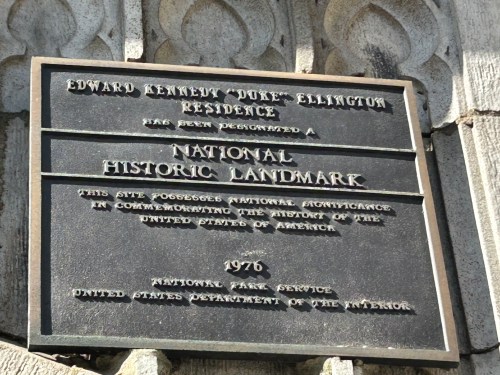
Places in Black History: St. Nicholas Avenue, Harlem, New York, New York

IMG_0659

Cultural Literacy: Rosenberg Case

Here is a Cultural Literacy worksheet on the Rosenberg Case. This is a half-page worksheet with a reading of three sentences and three comprehension questions. The information in the reading is out of date, as it is quite clear at this point that Julius Rosenberg was in fact spying for the Soviet Union. Ethel’s case, on the other hand, is not so clear cut.

This is a case in which I have been intermittently interested in over the years. When I saw Sidney Lumet’s 1983 film of E.L. Doctorow’s novel The Book of Daniel, I recognized immediately that it was a thinly fictionalized account of the Rosenberg Case. Likewise, of course, Doctorow’s novel. This encounter then led me to Louis Nizer’s book The Implosion Conspiracy, a study of the Rosenberg Case.

If you find typos in this document, I would appreciate a notification. And, as always, if you find this material useful in your practice, I would be grateful to hear what you think of it. I seek your peer review.

Orson Welles

Orson (George) Welles: (1915-1985) U.S. film director, actor, and producer. Born in Kenosha, Wisconsin, he began directing on stage at 16 and made his Broadway debut in 1934. He directed an all-black cast in Macbeth for the Federal Theater Project. In 1937 he and John Houseman formed the Mercury Theater, creating a series of radio dramas and attempting to mount Marc Blitzstein’s The Cradle Will Rock in the face of determined opposition, and winning notoriety with their panic-producing broadcast of War of the Worlds (1938). Welles then moved to Hollywood, where he cowrote, directed, and acted in the classic Citizen Kane (1941), noted for its innovative narrative technique and atmospheric cinematography and considered the most influential movie in film history. His other films include The Magnificent Ambersons (1943), The Stranger (1946), The Lady from Shanghai (1948), Othello (1952), The Trial (1963), Touch of Evil (1958) and Chimes at Midnight (1966). His problems with Hollywood studios curtailed future productions, and he moved to Europe. He was also notable as an actor in Jane Eyre (1944), The Third Man (1949), and Compulsion (1959).

Excerpted from: Stevens, Mark A., Ed. Merriam-Webster’s Collegiate Encyclopedia. Springfield, Massachusetts: Merriam-Webster, 2000.