Tag Archives: black history

Cultural Literacy: Scott Joplin

Here is a Cultural Literacy worksheet on Scott Joplin. This is a half-page worksheet with a reading of two relatively simple sentences and two comprehension questions. Just the basics on this innovative and groundbreaking African American pianist and composer.

If you find typos in this document, I would appreciate a notification. And, as always, if you find this material useful in your practice, I would be grateful to hear what you think of it. I seek your peer review.

Carter G. Woodson on the Oppressor’s Methodology

“If you teach the Negro that he has accomplished as much good as any other race he will aspire to equality and justice without regard to race. Such an effort would upset the program of the oppressor in Africa and America. Play up before the Negro, then, his crimes and shortcomings. Let him learn and admire the Hebrew, the Greek, the Latin and the Teuton. Lead the Negro to detest the man of African blood—to hate himself. The oppressor may then conquer, exploit, oppress and even annihilate the Negro by segregation without fear or trembling. With the truth hidden there will be little expression of thought to the contrary.

The American Negro has taken over an abundance of information which others have made accessible to the oppressed, but he has not yet learned to think and plan for himself as others do for themselves. Well might this race be referred to as the most docile and tractable people on earth. This merely means that when the oppressors once start the large majority of the race in the direction of serving the purposes of their traducers, the task becomes so easy in the years following that they have little trouble with the masses thus controlled. It is a most satisfactory system, and it has become so popular that European nations of foresight are sending some of their brightest minds to the United States to observe the Negro in ‘inaction’ in order to learn how to deal likewise with Negroes in their colonies. What the Negro in America has become satisfied with will be accepted as the measure or what should be allotted him elsewhere. Certain Europeans consider the ‘solution to the race problem in the United States’ one of our great achievements.”

Excerpted/Adapted from: Woodson, Carter G. The Mis-education of the Negro. Eastford, CT: Martino Fine Books, 2018.

The Weekly Text, 6 February 2026, Black History Month Week I: 27 Pages of Annotations (Covering All 17 Chapters) on Chimamanda Ngozi Adichie’s Novel “Purple Hibiscus”

OK–Black History Month 2026 has arrived. As I say every year, at Mark’s Text Terminal every month is Black History Month because Black History is American History. At the same time, far be it from me to second guess a person of Carter G. Woodson’s stature; Black History Month is his brainchild. This month I have a couple of new things to roll out, developed in the year since the last time the calendar spun around to February.

So let’s start out with these 27 pages of annotations I prepared to accompany all 17 chapters of Chimamanda Ngozi Adichie’s first novel Purple Hibiscus. As you may know, Ms. Adichie is a member of a group of writers known as the “Children of Achebe” (about which I heard a great deal on a public radio program several years ago, and can now find no credible source for citation on the Internet). Artificial Intelligence (which I think dubious at best) yields a list of names that include Ms. Adichie, as well as Helon Habila, Chigozie Obioma, and Sefi Atta.

Achebe, of course, refers the the late, great, Chinua Achebe, whose novel Things Fall Apart is universally regarded as a masterpiece of post-colonial literature. Purple Hibiscus is also an exemplary post-colonial novel. And it’s difficult to get past the first sentence of this fine book without noticing Ms. Adichie’s homage to Chinua Achebe: “Things started to fall apart at home when my brother, Jaja, did not go to communion and Papa flung his heavy missal across the room and broke the figurines on the etagere.”

Finally, in preparing this post, I intended to refer to material I’d prepared and published for Ms. Adichie’s short book (pamphlet, really, and literally the transcript of a TED talk), We Should All Be Feminists. To my surprise, I somehow never staged this material for inclusion in this blog. I have two versions of the unit, one complete and one incomplete. The complete unit was prepared for a small class of emergent readers and writers, so there is a lot of material. Needless to say, now that I have uncovered this lapse, I have this material in the warehouse and ready for publication.

If you find typos in these documents, I would appreciate a notification. And, as always, if you find this material useful in your practice, I would be grateful to hear what you think of it. I seek your peer review.

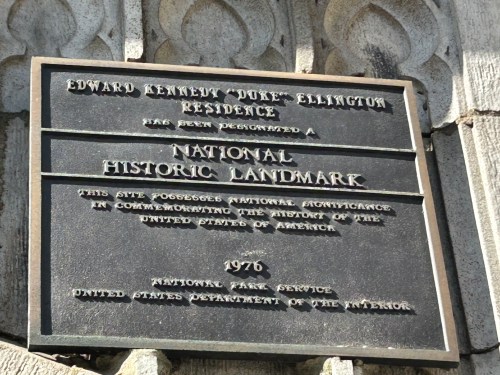
Places in Black History: St. Nicholas Avenue, Harlem, New York, New York

IMG_0659

The Weekly Text, 7 March 2025, Women’s History Month Week I: A Reading and Comprehension Worksheet on Harriet Tubman

OK, we’ve rounded to corner to March, during which Mark’s Text Terminal, conforming to the latest consensus, observes Women’s History Month. The first Weekly Text for this month is this reading on Harriet Tubman along with its accompanying vocabulary-building and comprehension worksheet.

If you find typos in these documents, I would appreciate a notification. And, as always, if you find this material useful in your practice, I would be grateful to hear what you think of it. I seek your peer review.

Langston Hughes: Excerpt from “Theme for English B”

“As I learn from you,

I guess you learn from me—

although you’re older—and

white

and somewhat more free.

This is my page for English B.”

Langston Hughes

Theme for English B l. 37″ (1951)

Excerpted from: Shapiro, Fred, ed. The Yale Book of Quotations. New Haven: Yale University Press, 2006.

Cultural Literacy: Lagos

Here is a Cultural Literacy worksheet on Lagos, which is, of course, the largest city in Nigeria and that nation’s capital until 1991, when the government moved the capital to Abuja, in the center of the country.

This is a half-page worksheet with a reading of one very long compound sentence, separated by a semicolon, and a two-part comprehension questions on one line.

If you find typos in this document, I would appreciate a notification. And, as always, if you find this material useful in your practice, I would be grateful to hear what you think of it. I seek your peer review.

Brian and Eddie Holland

“Brian and Eddie Holland (originally Edward): U.S. songwriters and producers. In 1962 the Detroit-born brothers Brian (b.1941) and Eddie (b.1939) formed a team with Lamont Dozier (b.1941) which subsequently created a series of hits for almost every artist on the Motown label, and helped define its characteristic sound through blending elements of gospel music and rhythm and blues with elaborate arrangements. Their songs include ‘Baby Love,’ ‘Stop! In the Name of Love’ (two of the seven number one hits they wrote for the Supremes), ‘Heat Wave,’ ‘Baby I Need Your Loving,’ and dozens of other hit for such artists as Marvin Gaye and the Temptations.”

Excerpted/Adapted from: Stevens, Mark A., Ed. Merriam Webster’s Collegiate Encyclopedia. Springfield, Massachusetts: Merriam-Webster, 2000.

Cultural Literacy: Harlem Renaissance

Here is a Cultural Literacy worksheet on the Harlem Renaissance. This is a half-page worksheet with a reading of two sentences (one of which, longish, presents a nice summary list of writers associated with the Harlem Renaissance) and three comprehension questions.

Once again, this is a short document that serves as a good general introduction to one of the most significant and consequential moments in 20th-century American cultural history.

If you find typos in this document, I would appreciate a notification. And, as always, if you find this material useful in your practice, I would be grateful to hear what you think of it. I seek your peer review.

Sarah Breedlove Walker

“Sarah Breedlove Walker originally Sarah Breedlove: (1867-1919) U.S. businesswoman and philanthropist, the first black female millionaire in the U.S. Born near Delta, Louisiana, she was a widowed washerwoman with a daughter to support in 1905 when she developed a method for straightening curly hair. She founded the Madame C.J. Walker Manufacturing Co. to sell her treatment, and her door-to-door saleswomen became familiar figures in the black communities in the U.S. and the Caribbean. In 1910 she moved her company to Indianapolis. She augmented her earnings with shrewd real-estate investments, and she donated two-thirds of her fortune to charitable and educational institutions. Her daughter, A’lelia Walker Kennedy, hosted salons where artists and cultural figures mingled during the Harlem Renaissance.”

Excerpted/Adapted from: Stevens, Mark A., Ed. Merriam Webster’s Collegiate Encyclopedia. Springfield, Massachusetts: Merriam-Webster, 2000.