Tag Archives: fiction/literature

Rebecca West on Anthologies

“Anthologies are mischievous things. Some years ago there was a rage for chemically predigested food, which was only suppressed when doctors pointed out that since human beings had been given teeth and digestive organs they had to be used or they degenerated very rapidly. Anthologies are predigested food for the brain.”

Rebecca West

Excerpted from: Sherrin, Ned, ed. The Oxford Dictionary of Humorous Quotations. New York: Oxford University Press. 1996.

Colette

“Colette in full Sidonie-Gabrielle Colette: (1873-1954) French writer. Her first four Claudine novels (1900-03), the reminiscences of a libertine ingenue, were published by her first husband, an important critic, under his pen name, Willy. She later worked as a music hall performer. Among her later works are Cheri (1920), My Mother’s House (1922), The Ripening Seed (1923), The Last of Cheri (1926), Sido (1930), and Gigi (1944; musical film, 1958), a comedy about a girl raised to be a courtesan. Her novels of the pleasures and pains of love are remarkable for their exact evocation of sounds, smells, tastes, textures, and colors. She collaborated with Maurice Ravel on the opera L’enfant et les sortileges (1925). In her highly eventful life, she freely flouted convention and repeatedly scandalized the French public, but by her late years she had become a national icon.”

­­­­­­­­­

Excerpted from: Stevens, Mark A., Ed. Merriam Webster’s Collegiate Encyclopedia. Springfield, Massachusetts: Merriam-Webster, 2000.

Cultural Literacy: Ayn Rand

Here, against my better judgment, is a Cultural Literacy worksheet on Ayn Rand. This is a full-page worksheet with a reading of two sentences–beware the first of them, a doozy of a compound that I am convinced would best be revised and shortened for struggling and emergent readers–and four comprehension questions.

Why “against my better judgment”? I suppose because I find Ayn Rand’s (born in Russia as Alisa Zinoyevna Rosenbaum) “objectivist” philosophy to be little more than a simple minded rationale, dressed up in the most tawdry, yet soaring, rhetoric, for the worst kind of selfishness.

If you find typos in this document, I would appreciate a notification. And, as always, if you find this material useful in your practice, I would be grateful to hear what you think of it. I seek your peer review.

Sarah Barnwell Elliot

“Sarah Barnwell Elliott: (1848-1928) American writer and feminist activist. Elliott was one of the “local color” (or regionalist) writers, and is best known for her novel Jerry (1891). Her most powerful fiction represents the displaced slave-owning class into which she was born, as it confronts hard economic times and a new social order. Elliott was a feminist activist in the South and led the fight for Tennessee to ratify the 19th amendment. Her fiction is often valued for its liberal attitudes toward women, as in The Making of Jane (1901). Her stories about race relations during Reconstruction are extremely problematic: the portraits of ex-slaves in An Incident, and Other Stories (1899) are both nostalgic and derogatory, and seem to contradict her family’s sense of noblesse oblige and well-known resistance to virulent racism. The title story is the first representation in American literature of a black man pursued by a lynch mob for raping a white woman. Elliott’s work raises questions about the attitudes toward race among Southern white women and the roles they played in reestablishing white supremacy in the postbellum South.”

Excerpted from: Murphy, Bruce, ed. Benet’s Reader’s Encyclopedia, Fourth Edition. New York: Harper Collins, 1996.

Cultural Literacy: Ella Wheeler Wilcox

Here is a Cultural Literacy worksheet on Ella Wheeler Wilcox, who authored the famous, if insipid, saying “Laugh, and the world laughs with you; weep, and you weep alone.” Her biography is quite rich, and she was apparently prolific.

This is a half-page worksheet with a reading of three sentences and three comprehension questions. A spare, but effective, introduction to a poet who, I’ll hazard a guess, is largely forgotten–which arouses the question: is any poet remembered today?

If you find typos in this document, I would appreciate a notification. And, as always, if you find this material useful in your practice, I would be grateful to hear what you think of it. I seek your peer review.

Lydia Maria Child

“Lydia Maria Child originally Lydia Maria Francis: (1802-1880) U.S. abolitionist. Born in Medford, Massachusetts, she wrote historical novels and a popular manual, The Frugal Housewife (1829), and founded the first children’s periodical, Juvenile Miscellany. After meeting William Lloyd Garrison in 1831, she became active in abolitionist work. Her Appeal in Favor of That Class of Americans Called Africans (1833) was widely read and induced many to join the abolitionist cause. She edited the National Anti-Slavery Standard (1841-43) and made her home a stage on the Underground Railroad.”

­­­­­­­­­

Excerpted from: Stevens, Mark A., Ed. Merriam Webster’s Collegiate Encyclopedia. Springfield, Massachusetts: Merriam-Webster, 2000.

Cultural Literacy: Harlem Renaissance

Here is a Cultural Literacy worksheet on the Harlem Renaissance. This is a half-page worksheet with a reading of two sentences (one of which, longish, presents a nice summary list of writers associated with the Harlem Renaissance) and three comprehension questions.

Once again, this is a short document that serves as a good general introduction to one of the most significant and consequential moments in 20th-century American cultural history.

If you find typos in this document, I would appreciate a notification. And, as always, if you find this material useful in your practice, I would be grateful to hear what you think of it. I seek your peer review.

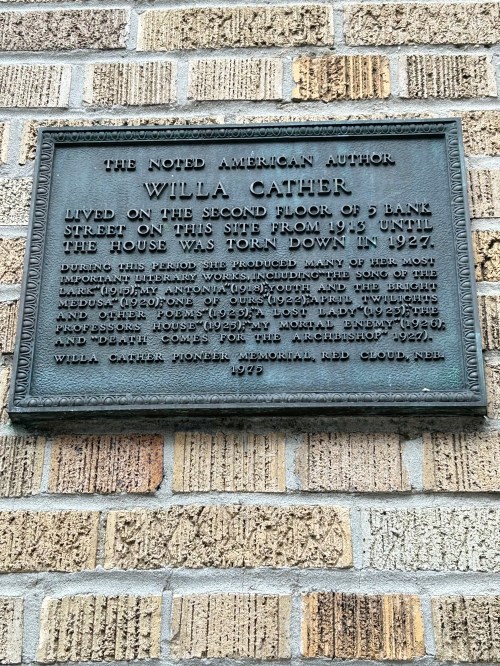
Places in Women’s History: Greenwich Village, New York, New York

IMG_0650

The Weekly Text, 14 February 2025, Black History Month Week II: A Reading and Comprehension Worksheet on the Harlem Renaissance

For the second month of Black History Month 2025, here is a reading on the Harlem Renaissance with its accompanying vocabulary-building and comprehension worksheet. This is a useful, one-page survey of key events and personalities of the Harlem Renaissance. In the end, however, it is only an introduction to one of the most fertile and consequential periods in American cultural history.

If you find typos in these documents, I would appreciate a notification. And, as always, if you find this material useful in your practice, I would be grateful to hear what you think of it. I seek your peer review.

Places in Black History: Riverside Drive, Harlem, New York, New York

IMG_0653IMG_0655