
Monthly Archives: March 2024

Seneca Falls Convention

“Seneca Falls Convention: (July 19-20, 1948) Assembly held at Seneca Falls, New York, that launched the U.S.s women’s suffrage movement. The meeting was initiated by Elizabeth Cady Stanton (who lived in Seneca Falls) and Lucretia Mott. Over 200 people attended the meeting including 40 men, The group passed the Declaration of Sentiments, a list of grievances and demands modeled on the Declaration of Independence that called on women to organize and petition for their rights. A controversial demand for the right to vote passed by a narrow margin.”

Excerpted from: Murphy, Bruce, ed. Benet’s Reader’s Encyclopedia, Fourth Edition. New York: Harper Collins, 1996.
Cultural Literacy: Margaret Mead

Here is a Cultural Literacy worksheet on Margaret Mead. This is a half-page document with a reading of two very long sentences which might be best broken up if you’re teaching struggling readers, and three comprehension questions.

If you find typos in this document, I would appreciate a notification. And, as always, if you find this material useful in your practice, I would be grateful to hear what you think of it. I seek your peer review.

Book of Answers: Zelda Fitzgerald

Did Zelda Fitzgerald write any novels? One, Save me the Waltz (1932).

Excerpted from: Corey, Melinda, and George Ochoa. Literature: The New York Public Library Book of Answers. New York: Simon and Schuster, 1993.

The Weekly Text, 8 March 2024, Women’s History Month Week 2: A Reading and Comprehension Worksheet on Anne Bradstreet

For the second Friday of Women’s History Month 2024, here is a reading on Anne Bradstreet with its attendant vocabulary-building and comprehension worksheet. She was, as you may know (and I didn’t, I think, because I thought she was a key figure in North American Protestantism somehow, so a theocrat of some sort I suppose) a poet; in fact, she was the first person to publish a volume of poetry in Great Britain’s North American Colonies.

If you find typos in these documents, I would appreciate a notification. And, as always, if you find this material useful in your practice, I would be grateful to hear what you think of it. I seek your peer review.

Image

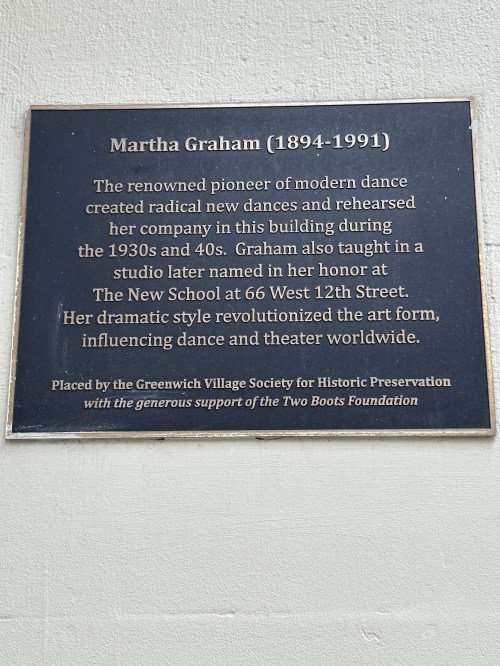
Places in Women’s History: Greenwich Village, New York, New York

IMG_0649

Sandra Day O’Conner

“Sandra Day O’Connor originally Sandra Day (b.1930) U.S. jurist. Born in El Paso, Texas, she studied law at Stanford University, graduating first in her class, and entered private practice in Arizona. She served as an assistant state attorney general (1965-69) before being elected in 1969 to the state senate, where she became the first woman in the U.S. to hold the position of majority leader (1972-74). After serving on the superior court of Maricopa County and the state court of appeals, she was nominated in 1981 by President Ronald Reagan to the U.S. Supreme Court and became the first female justice in the Court’s history. She proved to be a moderate and pragmatic conservative who sometimes sided with the Court’s liberal minority on social issues (e.g. abortion rights). She is known for dispassionate and meticulously researched opinions.”

­­­­­­­­­Excerpted from: Stevens, Mark A., Ed. Merriam Webster’s Collegiate Encyclopedia. Springfield, Massachusetts: Merriam-Webster, 2000.

Cultural Literacy: Frankenstein

Moving right along this morning, here is a Cultural Literacy worksheet on the novel Frankenstein. This is a full-page document with a reading of five sentences and four comprehension questions.

How has what is ostensibly a horror story (which I’ve always read as an allegory on the naivete of Enlightenment notions about the perfectibility of man) to do with Women’s History Month? Well, this novel’s author is Mary Shelley, who was also known as Mary Wollstonecraft Shelley after her mother, Mary Wollstonecraft, who was a pioneering feminist and author of A Vindication of the Rights of Woman.

And while I am conflicted about using these women’s husbands to identify them, the two men are important for understanding the milieu in which Mary Shelley and her mother lived. Mary Shelley came by her name through her marriage to Percy Bysshe Shelley, the major English romantic poet. Mary Wollstonecraft married William Godwin, the British journalist, political philosopher, and novelist who, if he were alive today, would be quickly dismissed by the far right wing of the Republican Party as a man of the “woke left.”

If you find typos in this document, I would appreciate a notification. And, as always, if you find this material useful in your practice, I would be grateful to hear what you think of it. I seek your peer review.

Dorothy Parker on Hollywood Money

“Speaking of Hollywood money, Mrs. Parker said: ‘It’s congealed snow; it melts in your hand.’”

Excerpted from: Drennan, Robert E., ed. The Algonquin Wits. New York: Kensington, 1985.

Cultural Literacy: Alice Paul

Here is a Cultural Literacy worksheet on Alice Paul. This is a full-page document with a reading of four sentences, all of them long, and the first a compound separated by a semicolon, and six comprehension questions. This worksheet is long enough to serve as independent practice, otherwise known as homework.

Did you know that Alice Paul was the first, in 1923, to write and propose an Equal Rights Amendment to the United States Constitution? You know, the one Phyllis Schlafly worked so hard to defeat in the 1970s? If you watched the FX miniseries Mrs. America  (which includes the extraordinary Uzo Aduba as Shirley Chisolm) you know something about this. Alice Paul also worked for the ratification of the 19th Amendment, affirming a woman’s right to vote, to the United States Constitution.

If you find typos in this document, I would appreciate a notification. And, as always, if you find this material useful in your practice, I would be grateful to hear what you think of it. I seek your peer review.

Hortense Callisher

“Hortense Calisher: (1911-2009) American novelist and short-story writer. Calisher’s first, partly autobiographical, stories appeared in The New Yorker. Many of her early stories featured Hester Elkin and her large Jewish family living in New York City. Her most frequently anthologized story, ‘In Greenwich, There Are Many Gravelled Walks’ (1951), focuses on a man, his loneliness, and a final promise of companionship. The full range of her short fiction is contained in Collected Stories (1975). Apart from the facts that she is an acknowledged master of style and that her work offers intricately drawn insights into her characters, Calisher’s writing defies easy classification. Characters in her first novel, False Entry (1961), reappear in an entirely different context in The New Yorkers (1969). Both Journal from Ellipsia (1965) and Queenie (1971) contain spoofs of American sexual mores, the former by presenting alternatives from another planet, the latter through the eyes of an ‘old-fashioned girl.’ Other novels include Texture of Life (1963), On Keeping Women (1977), and In the Palace of the Movie King (1993). In 1988, Calisher published a volume of memoirs, Kissing Cousins.”

Excerpted from: Murphy, Bruce, ed. Benet’s Reader’s Encyclopedia, Fourth Edition. New York: Harper Collins, 1996.