Tag Archives: lgbtq history

The Weekly Text, 15 August 2025: A Reading and Comprehension Worksheet on Alan Turing

If memory serves, I wrote the documents in this week’s Text, to wit a reading on Alan Turing and its attendant vocabulary-building and comprehension worksheet early on in my career for a computer-obsessed young fellow. Alan Turing certainly remains an fascinating figure. And if the 2014 motion picture The Imitation Game indicates anything, it is that there is still popular as well as historical interest in Turing.

It’s probably worth mentioning that the T in the acronym CAPTCHA stands for “Turing.” The full name is “Completely Automated Public Turing test to tell Computers and Humans Apart.”

If you find typos in these documents, I would appreciate a notification. And, as always, if you find this material useful in your practice, I would be grateful to hear what you think of it. I seek your peer review.

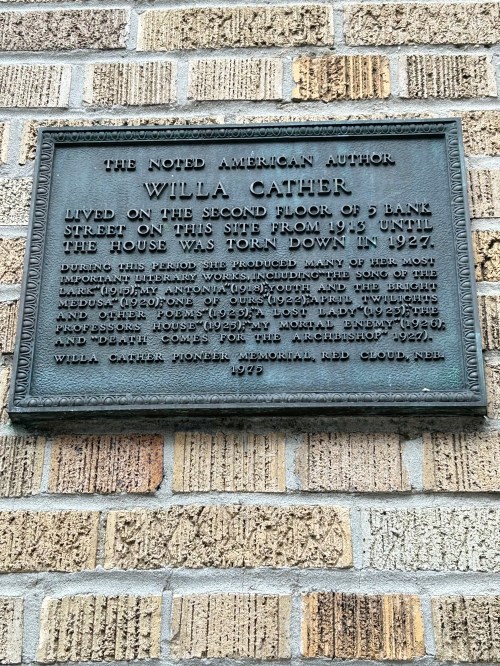
Places in Women’s History: Greenwich Village, New York, New York

IMG_0650

Quentin Crisp on Becoming a Writer

“There are three reasons for becoming a writer. The first is that you need the money; the second that you have something to say that you think the world should know; and the third is that you can’t think what to do with the long winter evenings.”

Quentin Crisp

Excerpted from: Sherrin, Ned, ed. The Oxford Dictionary of Humorous Quotations. New York: Oxford University Press. 1996.

Margaret Mead on Sex and Gender

“Historically our own culture has relied for the creation of rich and contrasting values upon many artificial distinctions, the most striking of which is sex…. If we are to achieve a richer culture, rich in contrasting values, we must recognize the whole gamut of human potentialities, and so weave a less arbitrary social fabric, one in which each diverse human gift will find a fitting place.”

Margaret Mead, Sex and Temperament in Three Primitive Societies conclusion (1935)

Excerpted from: Schapiro, Fred, ed. The Yale Book of Quotations. New Haven: Yale University Press, 2006.

Reinaldo Arenas

“Reinaldo Arenas: (1943-1990) Cuban novelist. A great innovator with an inexhaustible poetic imagination, Arenas suffered years of repression of his ‘lack of realism’ and supposed decadence, as well as for his political dissent and open homosexuality. He exiled himself to New York in 1980. The novel that launched Arenas was El mundo alucinante (1969; tr Hallucinations, 1971), an allegorical reconstruction of the adventures of Fray Servando Teresa de Mier, a Mexican priest of the late 18th century, whose subversive mystical thought paved the way for Mexican independence. Arenas’s central work was ‘pentagony’ of five novels dealing with life in Cuba before and after Castro, consisting of Celestino antes del alba (1967; tr Singing from the Well, 1988); El palacio de las blanquistas mofetas (The Palace of the Very White Skunks, 1980); Otra vez del mar (1982; tr Farewell to the Sea, 1986); El color del verano (The Color of Summer, 1991); and El asalto (1991; tr The Assault, 1993). Other books include La vieja rosa (1980; tr Old Rosa, 1989), depicting a woman’s aging process within a society whose traditional values have been profoundly altered, and Arturo, la Estrella ms brillante (1984; tr Arturo, the Shining Star, 1992), about the traumatic experiences of a homosexual in a concentration camp. Ill with AIDS and no longer able to write, Arenas committed suicide in 1990 after completing his last works. He left two extreme visions of himself, the tender recollections of Adis a Mam (Good-bye to Mama, 1994) and his controversial autobiography, Antes que anochezca (1992; tr Before Night Falls, 1993), which portrays his troubled youth and sexual excesses.”

Excerpted from: Murphy, Bruce, ed. Benet’s Reader’s Encyclopedia, Fourth Edition. New York: Harper Collins, 1996.

Book of Answers: Christopher Isherwood and Cabaret

What work by Christopher Isherwood was the basis for the musical Cabaret (1968)? Cabaret was based on the play I Am a Camera (1951) by John Van Druten, which was in turn based on Isherwood’sSally Bowles,” a story appearing in Goodbye to Berlin. Isherwood lived in Berlin in the early 1930s.

Excerpted from: Corey, Melinda, and George Ochoa. Literature: The New York Public Library Book of Answers. New York: Simon and Schuster, 1993.

Ivy Compton-Burnett

“Ivy Compton-Burnett (later Dame Ivy): (1887-1967) British novelist. She graduated from the University of London and published her first novel, Dolores, in 1911. Her second, Pastors and Masters (1925), introduced the style—employing clipped, precise dialogue to reveal her characters and advance the plot—that made her name. Her novels often dealt with struggles for power: Men and Wives (1931) featured a tyrannical mother. A House and Its Head (1935) a tyrannical father. She was created Dame of the British Empire in 1967.”

­­­­­­­­­Excerpted from: Stevens, Mark A., Ed. Merriam Webster’s Collegiate Encyclopedia. Springfield, Massachusetts: Merriam-Webster, 2000.

Colette on the Pitfalls of a Happy Childhood

“A happy childhood is poor preparation for human contact.”

Colette

Excerpted from: Winokur, Jon, ed. The Big Curmudgeon. New York: Black Dog & Leventhal, 2007.

Character Sketch

“Character Sketch (noun): A brief descriptive portrait in writing of an individual, usually with close observation of his or her distinctive traits.

‘In 1928 a private press published her character sketch of the Sapphic poetess Renee Vivien, born Pauline Tern, in London, of an English father and an American mother, a fragile neurotic figure who spent most of her short, self-destructive life in Paris, maintained in mysterious semi-Oriental elegance and living on spiced foods and alcohol in a garden apartment by chance next to Colette’s, near the Bois de Boulogne.’ Janet Flanner, Janet Flanner’s World”

Excerpted from: Grambs, David. The Random House Dictionary for Writers and Readers. New York: Random House, 1990.

Cultural Literacy: Willa Cather

She’s not much read today (though I have loved the books of hers I’ve read), but I think this Cultural Literacy worksheet on novelist Willa Cather ought to have some currency in our secondary classrooms in the United States (at least!). This is a half-page worksheet with a reading of one compound sentence with two comprehension questions.

If you find typos in this document, I would appreciate a notification. And, as always, if you find this material useful in your practice, I would be grateful to hear what you think of it. I seek your peer review.